The AI Enablement Brief · Mar 18, 2026
Are You an Operator or an Orchestrator?
Part 3 - and the most important question you'll answer about your career this year.
Last week ago I started this series by writing about why agents are a big deal.
On Monday I showed three workflows I actually built and today, I want to close with the question that actually matters: what does all of this mean for you?
Not abstractly. Concretely. Your role, your team, your career.
The Number That Changes Everything
Here’s the stat I keep coming back to: 2 of the 4 biggest technology unlocks I’ve experienced in AI over the last four years happened in the last three months.
That’s not a product cycle. That’s not iteration. When half of your most significant observations in four years cluster into a single quarter, you’re watching acceleration — not progress.
Back-to-back in one week: Base44 released their Superagents, bringing OpenClaw-like technology to everyday users. A day later, Perplexity announced their personal computer system — run agents locally on a Mac Mini, no setup required. Both pointing at the same underlying shift: AI that doesn’t wait for you to prompt it. AI that has a job.
That shift is about to hit every role in knowledge work.
The Proof Is Already In
We don’t have to speculate. We can look at software development, where this transition already happened.
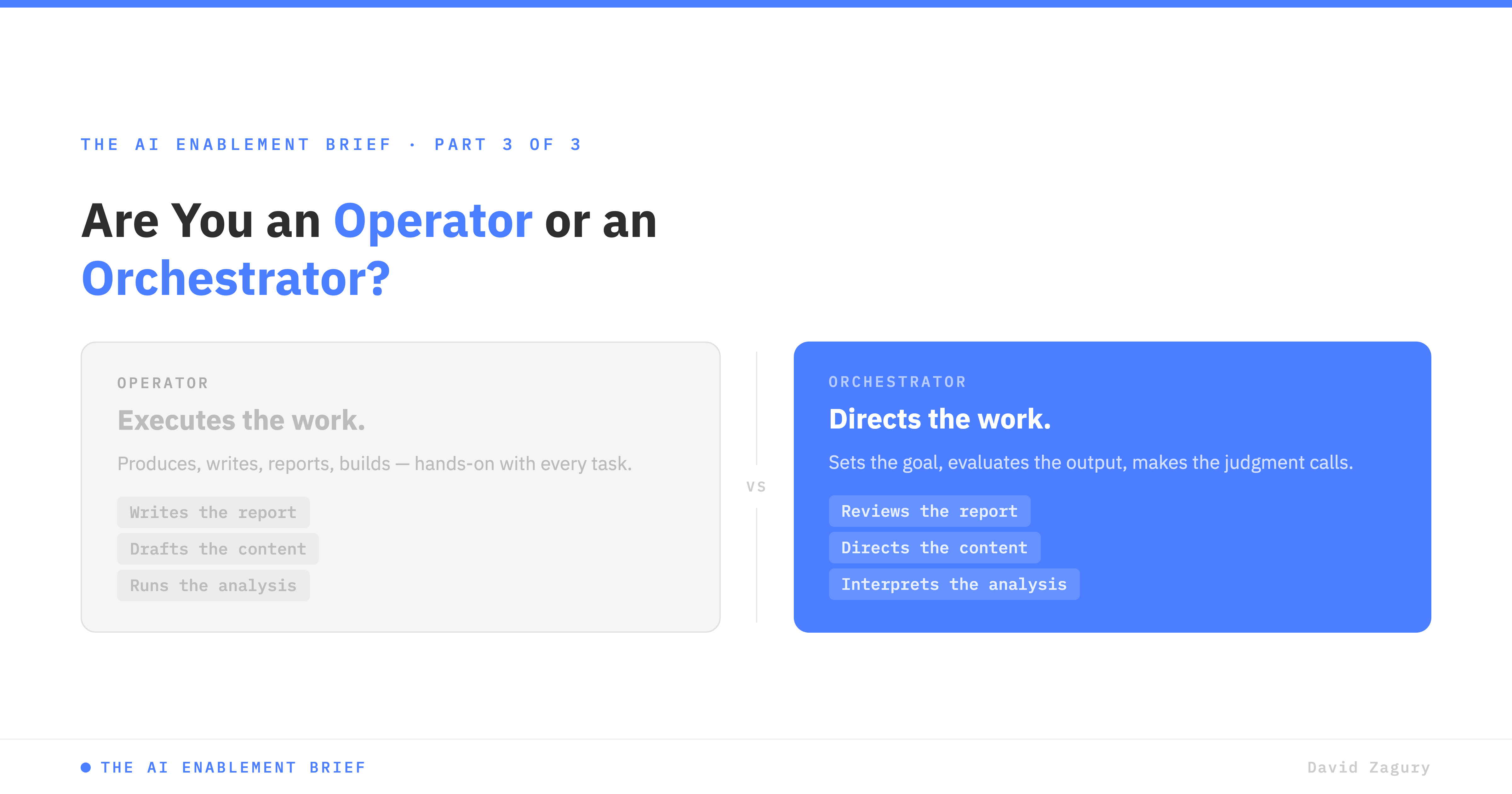
Engineers used to write code from scratch. That was the job — the primary creative and technical act. Now they spend more time auditing, reviewing, and directing AI-generated code than writing it themselves. Their titles didn’t change. Their actual work did. They went from producers to supervisors. From operators to orchestrators.
That transition happened faster in software because the tools arrived there first. And the engineers who adapted fastest are now operating at a level of output and leverage that would have seemed impossible two years ago.
The same transition is coming to every knowledge work function. It’s not a question of whether — it’s a question of when, and whether you’re building the right skills now or catching up later.
What the Orchestrator Actually Does
An orchestrator sets the goal and the standard. They direct the agent — what to monitor, what to produce, what threshold triggers a review. They evaluate the output, catch what’s off, and make the calls that require real judgment. They’re not hands-off. They’re differently hands-on.
I can imagine a future — not far off — where every employee is equipped with a team of AI agents that share context and integrate deeply into the tools they use every day. Not a single assistant. A team. With memory, specialization, and the ability to hand off tasks between each other.
In that world, your value isn’t in doing the work. It’s in directing it. Knowing what good looks like. Catching what’s wrong. Making the calls that require context, taste, and accountability.
That’s the orchestrator’s job. And it’s a genuinely different skill set than most of us were trained for.
What This Means If You’re in Marketing
Marketing is one of the functions where this shift hits hardest — and fastest — because so much of our work is operational.
Campaign reporting. Content production. Competitive monitoring. Audience segmentation. Budget modeling. These aren’t creative acts — they’re execution tasks.
The kind of work agents are purpose-built for. They’ll handle it.
What’s left is the part that actually requires you: strategy, relationships, creative direction, judgment.
The work that needs context about the client, taste in the craft, accountability when things go sideways.
The marketers who pull ahead won’t be the ones who resist this. They’ll be the ones who get ahead of it — who start building the orchestration muscle now, before it becomes tablestakes.
The adoption gap isn’t about access anymore. Most of us have the same tools. The gap is in integration. In who has actually woven this into how they work, not just how they experiment on a Tuesday afternoon.
The One Hour That Compounds
Start with an audit. Look at your week and ask: what am I doing that follows a pattern? A data source, a repeatable process, an output someone reviews. If that describes a workflow you run regularly, it’s a candidate for an agent.
Then build one. Not to eliminate your involvement — to handle the operational layer so you can focus on the judgment layer. Start smaller than you think. One workflow, one agent, one hour to set it up. That hour compounds every day after.
And start thinking about what the orchestrator version of your role looks like. What decisions still require you? Which ones can be delegated? What does directing AI actually mean in your specific context? Those answers are your competitive edge for the next 12 months.
The work isn’t disappearing. It’s moving up the stack.
Are you an operator or an orchestrator?