The AI Enablement Brief · Mar 26, 2026
The Two Halves of Enablement
AI innovation is the easy part. Change management is where enablement actually lives.
AI enablement is two jobs disguised as one. And most of us are only doing the fun half.
When we talk about enablement, we usually mean one thing: helping people use AI effectively. But enablement is actually two distinct disciplines fused together, and we keep treating them as one.
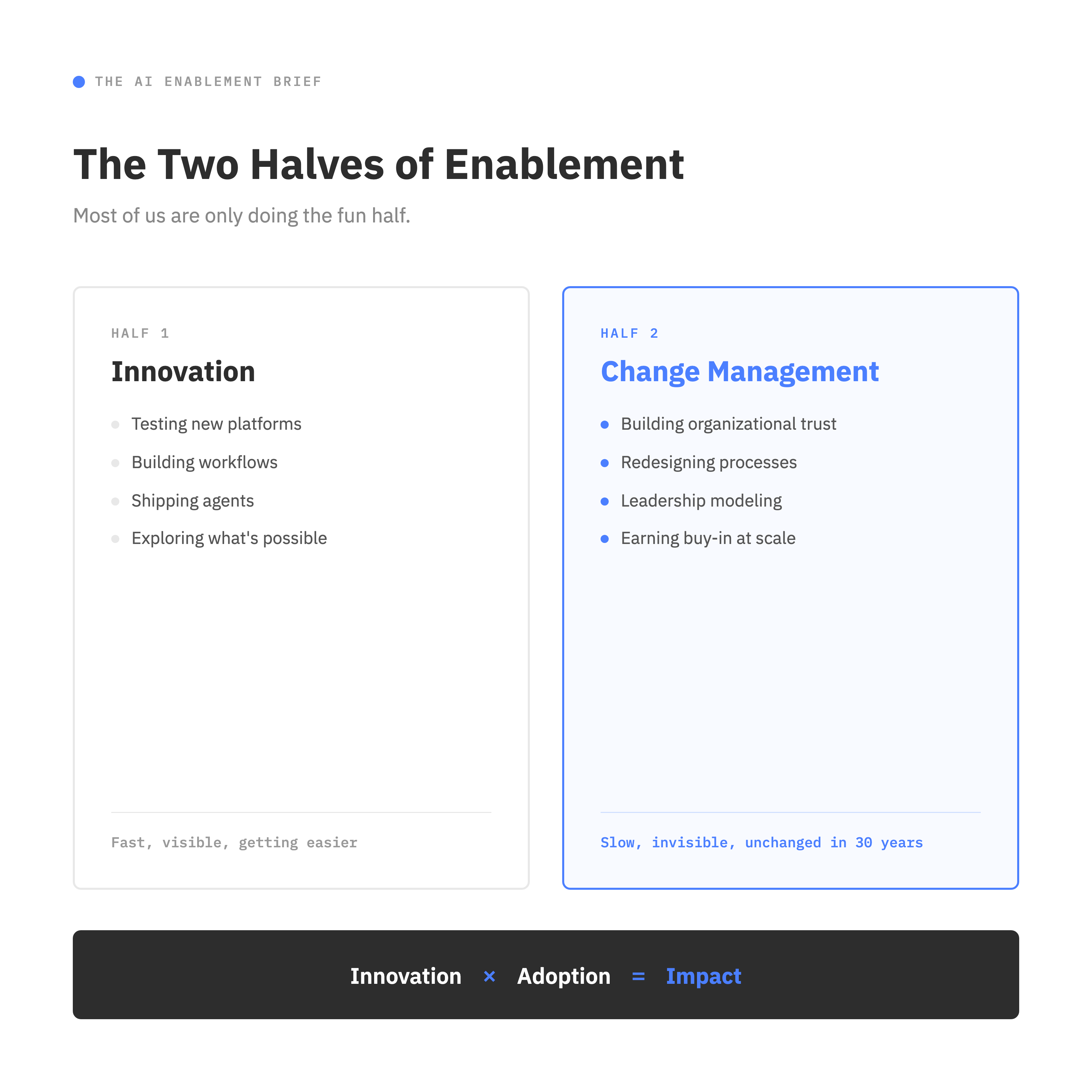
The first half is innovation. Testing new models. Building workflows. Shipping agents. Exploring what’s possible. This half is fast, energizing, and getting easier every week. The barriers to entry have essentially collapsed — anyone with curiosity and a laptop can build something meaningful in a weekend.
The second half is change management. Getting an entire organization to adopt, trust, and sustain those innovations. Redesigning processes. Building confidence. Earning buy-in from people who didn’t ask for any of this. This half is slow, frustrating, and hasn’t gotten meaningfully easier in thirty years.
But being good at Half 1 doesn’t make you good at Half 2. In fact, it might make you worse at it.
The more naturally you innovate, the harder it is to understand why everyone else isn’t keeping up.
The Fun Half
Most of us — myself included — over-index on innovation.
And it makes sense. Half 1 is where the dopamine is. You build something, it works, you move on to the next thing. It’s visible. It’s rewarding. It’s entirely within your control.
Half 2 is the opposite. You can’t control whether someone trusts a new workflow. You can’t force a team to change a process they’ve relied on for years. You can’t shortcut the slow, human work of getting people comfortable with a new way of operating.
There’s no demo for that.
So we keep building. We keep innovating. And we keep wondering why the organization isn’t moving at the same pace.
78% of leaders say AI adoption is outpacing their ability to manage the changes it creates. That’s not a failure of technology. That’s the gap between Half 1 and Half 2, measured at scale.
The Multiplication Problem
Here’s the math that most AI strategies ignore: Innovation × Adoption = Impact.
If either side is zero, the result is zero.
88% of organizations are using AI in at least one function.
That’s Half 1 — widespread, growing, impressive on paper. But nearly two-thirds of those organizations haven’t begun scaling AI across the enterprise. Half 2 is missing. And without it, all that innovation is just a collection of isolated pilots that never compound into anything.
Gartner projects that 40% of agentic AI projects will fail by 2027. Not because the agents don’t work — but because organizations are automating broken processes instead of redesigning them. That’s what happens when you invest in innovation without investing equally in adoption. You scale the dysfunction faster.
Only 23% of organizations have achieved operational AI deployments with measurable financial impact. Twenty-three percent. In an era where the tools are essentially free and the models improve every quarter. The bottleneck was never the technology. It’s the organizational capacity to absorb change.
What Half 2 Actually Looks Like
Change management sounds like a corporate buzzword. It’s not. It’s the boring, unglamorous, absolutely essential work of making innovation stick. And it doesn’t look like a training deck or an all-hands webinar.
It looks like a leader using the AI workflow themselves — visibly, consistently — before asking their team to adopt it. People follow behavior, not memos.
It looks like redesigning the process around the tool, not bolting the tool onto the old process. If you automate a broken workflow, you just get a faster broken workflow.
It looks like starting with the smallest possible win. Not the most impressive agent. Not the most ambitious automation. The one thing that saves someone fifteen minutes a day and earns enough trust to try the next thing.
It looks like patience. Real adoption takes quarters, not sprints. And the temptation to move on to the next innovation before the last one has landed is the single biggest threat to lasting impact.
52% of department-level AI initiatives operate without formal approval or oversight.
That’s a lot of builders building without anyone managing the change on the other side. It’s innovation without adoption — and it’s how organizations end up with dozens of AI experiments and zero transformation.
What This Means for You
If you’re leading AI enablement — formally or informally — ask yourself which half you’re spending more time on.
If the honest answer is innovation, you’re not alone. But you’re also not enabling. You’re prototyping. And prototyping without adoption is just a more sophisticated way of standing still.
A few starting points for the second half:
Use it first. Before you roll out a workflow to your team, use it yourself for two weeks. Document what broke, what confused you, what you’d change. That’s the gap between your prototype and their adoption.
Redesign, don’t bolt on. If the new tool plugs into the old process unchanged, the old process will win. Every time. Adoption requires rethinking how work flows, not just what tool does it.
Measure adoption, not innovation. How many workflows did you build this quarter is the wrong question. How many people are using the workflows you built last quarter — that’s the one that matters.
Earn trust in small increments. One workflow that saves someone real time does more for adoption than a presentation about the future of AI. Trust is earned in minutes saved, not slides delivered.
The Work
AI enablement is two jobs. Most of us are only doing the fun one.
The companies that pull ahead won’t be the ones innovating fastest.
They’ll be the ones who figured out the second half — the slow, human, unglamorous work of getting an organization to actually change.
That’s the hard part. That’s the work.