The AI Enablement Brief · Mar 16, 2026
The Workflows I Actually Built
Part 2 of 3 — I tried to build the same agent four times. The fifth try took seconds. Here's what I learned.
In part 1, I wrote about why agents are a big deal — the shift from reactive AI to systems that actually work on your behalf. Today I want to get specific. No frameworks. No predictions. Just three workflows I built this week using Base44 Superagents, and what it took to get them running.
One of them I’d been trying to build for months.
The 4-Failure Problem
I’ve wanted a Personal CFO agent for a long time. The idea was simple: connect my financial data and be able to ask questions about it conversationally — cash flow, transactions, spending by category — the way you’d talk to an advisor, not query a spreadsheet.
I tried Gemini first. Couldn’t write Python or parse through large data sets the way I needed. Then Base44’s App Builder — the Google Sheet data wasn’t pulling in consistently. Then Claude Code — underwhelming on the live sheet connection, and getting it to stay synced was a constant struggle. Then Claude Cowork — better at many things, but it does far better with a static file than a live Google Sheet. The second you want live data from an online sheet, you’re installing the Chrome extension and crossing your fingers.
Four attempts. Four different tools. Same wall every time.
Then Base44 Superagents launched, and I had it up and running in seconds.
The Google Sheets integration was seamless. Now I interact with my full financial data via WhatsApp — I can ask about transactions, cash flow, investments, and get visualizations on demand. Monthly reports, automated. The thing I’d been trying to build for months became a morning I’ll probably never think about again.
That experience told me something important: it’s not that the idea was wrong. The infrastructure just wasn’t there yet. And now it is.

The Outreach Machine
Here’s a problem that’s become more relevant as vibe coding goes mainstream: building the product is no longer the hard part. Distribution is.
If you’re an indie builder or running a small operation, you’re probably spending a lot of time on cold and warm outreach — finding the right people, writing personalized messages, following up, tracking replies. It’s necessary work, but it’s operational. The kind of work agents were built for.
Here’s the workflow I set up: you start by giving the agent full context on what you’re building and who you’re targeting. It identifies your ICP and finds prospects. It connects to your email provider, writes personalized outreach drafts for your approval, sends them once you sign off, monitors replies, and drafts responses for your review. Daily. On a schedule.
Those seven steps — from ICP definition to reply management — take less than five minutes to configure.
The agent doesn’t replace your judgment. You still approve every message before it goes out. But the operational layer — the finding, the drafting, the monitoring — is fully handled.
The same thing applies to any outbound-heavy workflow. Sales development, partnership outreach, media relations. If it involves a list of people and a sequence of messages, an agent can manage the process.
The SEO Content Specialist
I connected my Search Console to an agent for mediaplan.ca. Every day, it monitors my traffic, top keywords, and CTR — then recommends new content to drive more organic visitors. But it doesn’t stop at the recommendation. It writes the full piece and publishes it to the site.
No prompt required. No check-in needed. It runs on a schedule and delivers output.
That’s what a true agentic workflow looks like. Not “AI helps you write content faster.” AI running a content operation end-to-end, surfacing its own priorities, executing on them, and compounding over time.
For marketers managing content for multiple clients or properties, this is the workflow worth paying attention to. One agent, one Search Console connection, and you have a content operation that never stops working. The human’s job becomes review and quality control — not production.
What These Three Have in Common
Looking at these three workflows together, a pattern emerges that’s worth naming.
Each one follows the same structure: a schedule, a data source, autonomous execution, and a human review layer. The agent doesn’t just respond to prompts — it initiates. It wakes up, does the work, and surfaces what it found. You’re not orchestrating it in real time. You set the parameters once, and it runs.
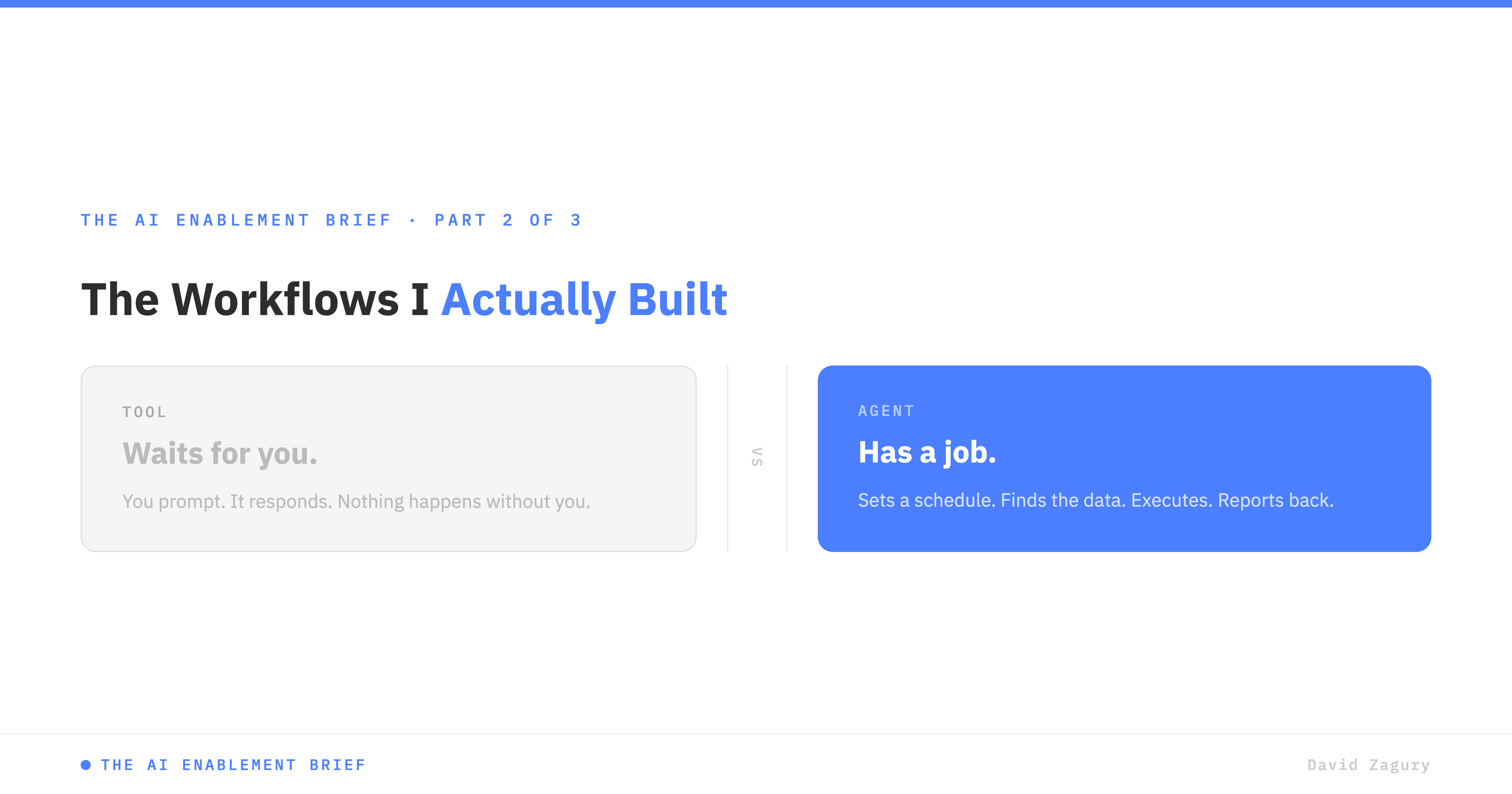
That’s the line between a tool and an agent. A tool waits for you. An agent has a job.
The practical implication: every repetitive, data-driven workflow in your business is now a candidate for this pattern. Not “use AI to speed it up” — but “hand it off entirely and review the output.” The judgment layer stays with you. The operational layer doesn’t have to.
What to Do With This
Pick one workflow you run on a schedule — weekly, daily, it doesn’t matter — and ask whether it fits this pattern: a data source, a repeatable process, an output you can review. If it does, it’s a candidate for automation.
The Personal CFO, the outreach machine, and the SEO specialist all started as frustrating manual processes. None of them required advanced technical knowledge to automate. They required finding the right tool and spending an hour setting it up.
That hour compounds. The content specialist runs every day. The outreach machine runs on its own timeline. The CFO is available whenever I need it, via WhatsApp.
Part 3 of this series will step back and look at what all of this means for the nature of knowledge work — and what it means for your role specifically. Stay tuned.